
It operated as a working jail for 161 years, closing in 1957. It is documented in the Acts and Resolves of the Rhode Island General Assembly, the United States Census, and period newspaper archives.
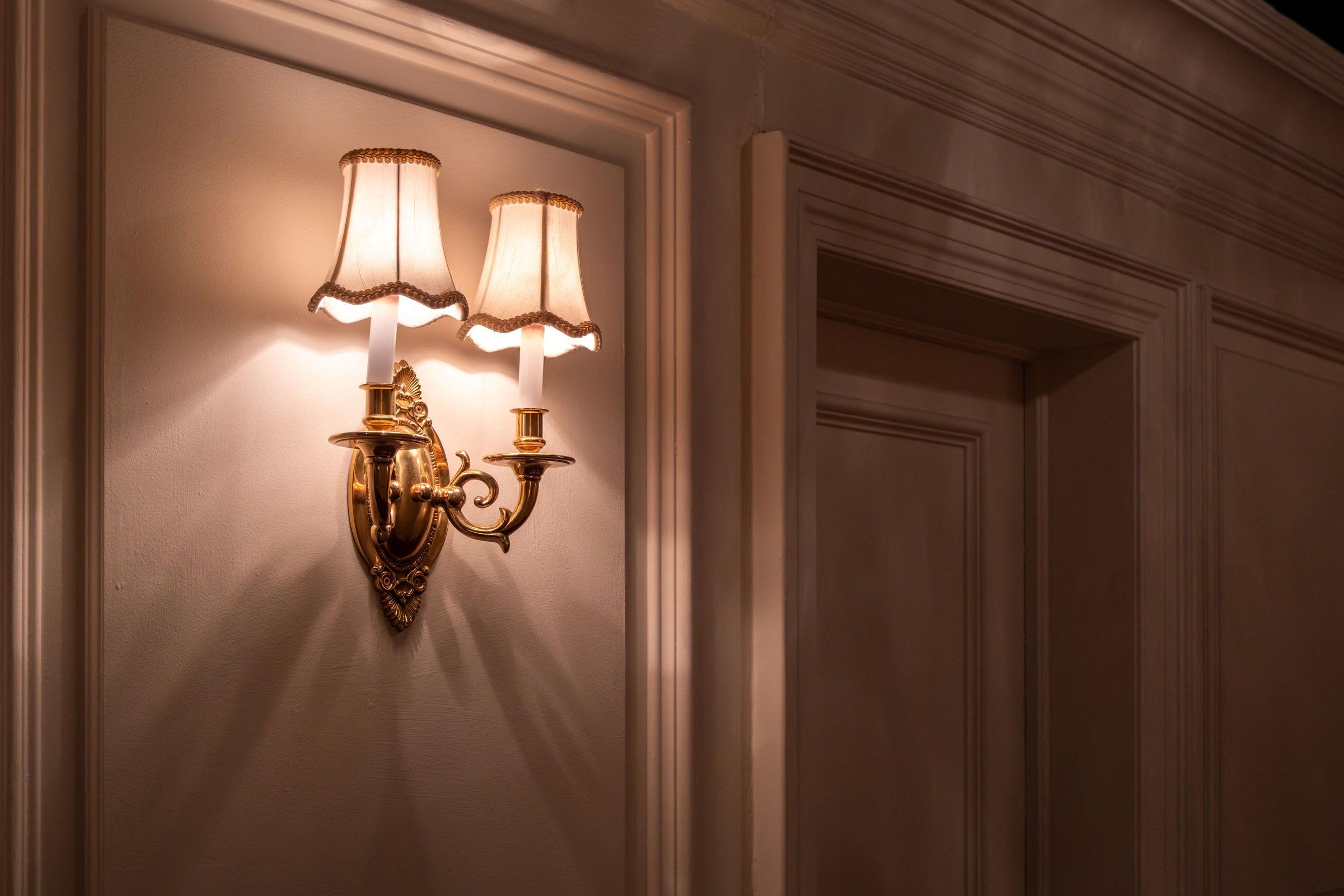
Every room in this building is tied to the documented record — named for the individuals who lived, worked, or passed through these walls between 1796 and 1957.
Named for Frederick E. Sunderland, the final jailkeeper of Kent County. A former Chief of Police of East Greenwich, he was appointed in 1928 and served until the jail closed in 1957. He and his wife Martha—”Mom” to the prisoners—lived in the building and were the last to oversee its original function. Fred was 81 years old when he locked the doors for the last time.
Named for Charles Burns, held for burglary in the 1890s and described by the Boston Globe in 1901 as the most difficult prisoner in twenty years of Everlin Smith’s service. He was stubborn, contrary, and ungovernable when Everlin was absent—yet even Burns submitted to her authority. His reputation as the jail’s worst inmate made him a fixture of its recorded history.
Named for William “Tug” McCaughey, a member of the notorious “wire gang” who was held at this jail in 1901. McCaughey implicated the gang in the nationally sensational murder of 24-year-old socialite May Fosburgh in Pittsfield, Massachusetts. The victim’s mother traveled to East Greenwich to interview him in his cell. The case made headlines across the country.
Named for George Congdon, a convicted murderer held at the Kent County Jail during Everlin Smith’s tenure. Congdon shot a man named Wilcox at Oakland Beach and was convicted before being transferred to Cranston state prison. His case was among the most serious to pass through these cells.

It is not. There is no haunted-house theatrics, no invented history, no dramatized embellishment. The building is 230 years old. Every name, every panel, every plaque references a primary source — General Assembly records, census data, newspaper archives, and court documents. The real stories are compelling enough on their own. They did not require a theme.
The Second Kent County Jail was commissioned by the Rhode Island General Assembly in January 1795 and completed by February 1796. Richard Mathewson of East Greenwich was appointed to build it, contributing 260 days of personal labor alongside his partner Earl Mowry. The final accounts were audited at a total cost of £1,751 14s 4¼d — roughly $4,208.83 at the time. The building has stood at 110 King Street for 230 years.
Fourteen. They range from 203 to 437 square feet and occupy both floors of the building — the residence side at the front, which once housed the jailkeeping family, and the jail block side at the rear, where the cells were. The two anchor suites are The Everlin Suite on the second floor, at 437 square feet, and The Mathewson Suite on the third floor, at 308 square feet.
Several, across 161 years of operation. In 1786, three prisoners broke gaol — one of the earliest documented escapes in Rhode Island, advertised with a fifteen-dollar reward in The United States Chronicle by Sheriff Richard Fry. In 1889, the first prisoners housed in the newly built brick jail escaped through fresh mortar within days of being moved in. In 1907, four prisoners sawed through the bars while stamping horses outside masked the noise — reported by the Boston Globe under the headline “Stamping Horses Drown Noise of Workers.” In 1950, Bernard Boulanger threw pepper in Martha Sunderland’s eyes and locked her in a cell before being recaptured at gunpoint within minutes. The building held most of them.
Fourteen rooms inside a building that held its last prisoner in 1957. The cells are still here. So is the ironwork, the brick, and the history. The sentence, this time, is yours to choose.